
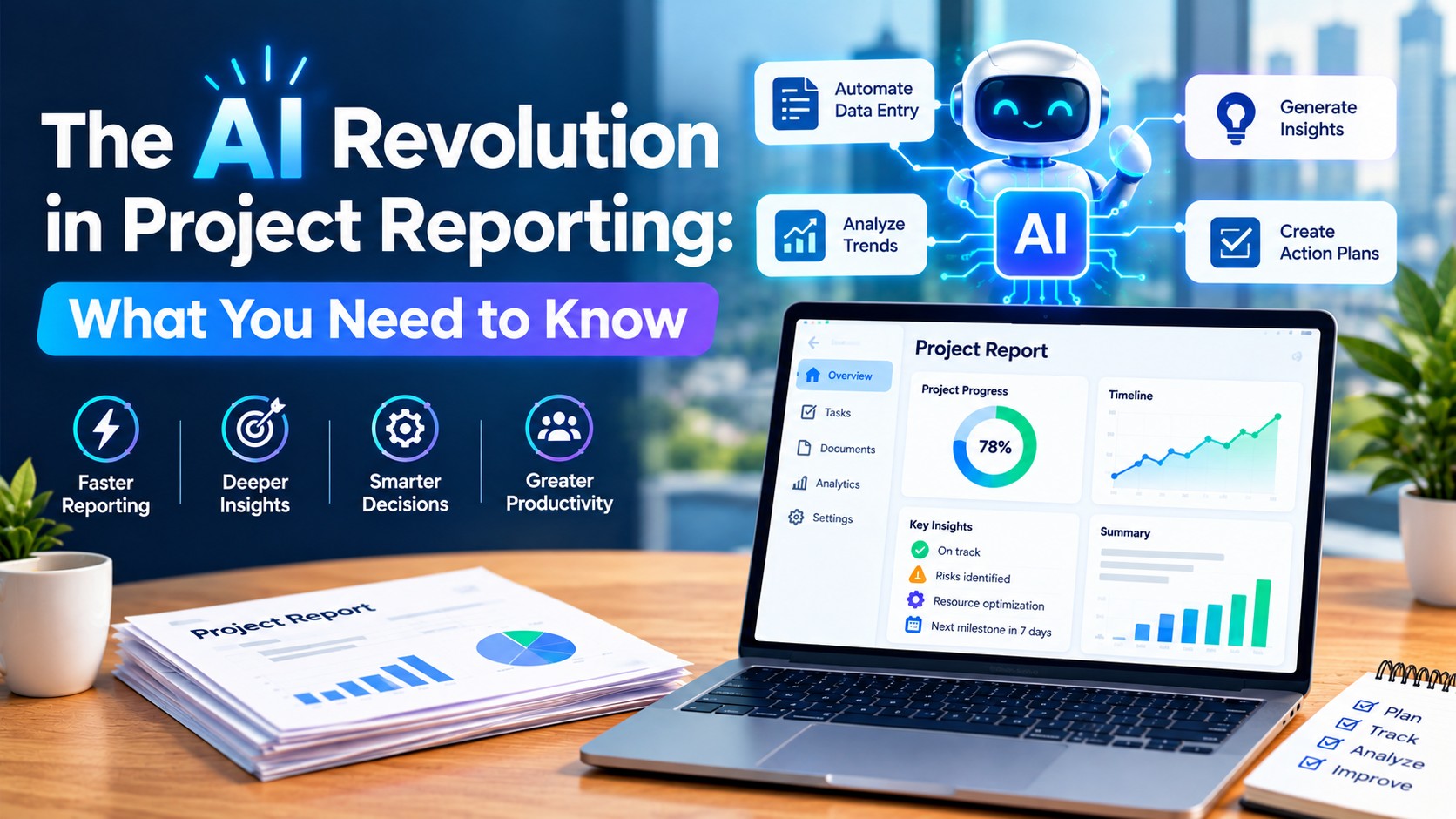

The AI Revolution in Project Reporting: What You Need to Know
In today's fast-paced business landscape, effective project reporting is no longer just about presenting historical data; it's about leveraging insights to drive future success. For decades, project reporting has been synonymous with manual data aggregation, spreadsheet gymnastics, and retrospective analysis. This labor-intensive process often led to delays, inaccuracies, and a reactive approach to project management.
Enter Artificial Intelligence (AI). The integration of AI into project reporting is not just an incremental improvement; it's a fundamental paradigm shift. AI is transforming how businesses collect, analyze, and interpret project data, promising unprecedented levels of efficiency, accuracy, and foresight. For business professionals and finance enthusiasts alike, understanding this revolution is crucial for staying competitive and making informed strategic decisions.
What is AI in Project Reporting?
AI in project reporting refers to the application of machine learning algorithms, natural language processing (NLP), and advanced analytics to automate, enhance, and optimize the entire reporting lifecycle. Instead of merely tracking progress, AI empowers systems to understand context, identify patterns, and even predict future outcomes.
Automation of Data Collection and Aggregation
One of the most significant pain points in traditional project reporting is the manual collection and consolidation of data from disparate sources – spreadsheets, project management software, financial systems, and communication platforms. AI-powered tools can automatically gather data, clean it, and integrate it into a unified dashboard. This not only saves countless hours but also drastically reduces the potential for human error, ensuring that reports are built on a foundation of reliable information.
Enhanced Data Analysis and Insights
Beyond automation, AI excels at processing vast datasets far more quickly and thoroughly than any human. It can identify subtle trends, correlations, and anomalies that might otherwise go unnoticed. For instance, AI can analyze task dependencies, resource allocation, budget expenditures, and team performance simultaneously, providing a holistic view of project health. This deep analytical capability translates into richer, more actionable insights, moving reporting from "what happened" to "why it happened" and "what will happen next."
Predictive Analytics and Risk Management
Perhaps the most transformative aspect of AI in project reporting is its ability to predict future project trajectories. By analyzing historical project data, current progress, and external factors, AI algorithms can forecast potential delays, budget overruns, or resource shortages. This predictive capability allows project managers and stakeholders to identify risks proactively, implement mitigation strategies before problems escalate, and adjust plans in real-time. Imagine knowing weeks in advance that a critical milestone is likely to be missed, giving you ample time to intervene.
Key Benefits for Businesses
The adoption of AI in project reporting offers a multitude of advantages that directly impact a company's bottom line and strategic agility.
Increased Efficiency and Time Savings
By automating repetitive tasks like data entry, compilation, and report generation, AI frees up project managers and their teams to focus on higher-value activities such as strategic planning, problem-solving, and stakeholder engagement. This efficiency gain can significantly reduce operational costs and accelerate project completion times.
Improved Accuracy and Reliability
Human error is an unavoidable factor in manual processes. AI systems, once properly trained and configured, perform calculations and data consolidations with unwavering precision. This leads to more accurate reports, instilling greater confidence in the data presented and the decisions based upon it. Reliable data is the bedrock of sound financial analysis, much like accurate calculations are essential for tools like an EMI calculator or an SIP calculator.
Better Decision-Making
With real-time, accurate, and insightful reports, stakeholders can make informed decisions more quickly. AI provides a clearer picture of project performance, resource utilization, and financial health, enabling leaders to allocate resources optimally, adjust strategies, and respond swiftly to changing market conditions or project challenges.
Proactive Risk Identification and Mitigation
AI's predictive capabilities enable businesses to move from reactive problem-solving to proactive risk management. Early warnings about potential issues allow teams to address them before they escalate into costly delays or failures, protecting project budgets and timelines.
Challenges and Considerations
While the benefits are compelling, integrating AI into project reporting isn't without its hurdles. Organizations must approach this transformation thoughtfully.
Data Quality and Integration
AI models are only as good as the data they're fed. Poor data quality, inconsistencies, or fragmented data sources can lead to flawed insights and erroneous predictions. Businesses must invest in robust data governance strategies and integration tools to ensure clean, consistent, and comprehensive data pipelines.
Ethical AI and Transparency
As AI plays a larger role in decision-making, questions of ethics, bias, and transparency become paramount. It's essential to understand how AI algorithms arrive at their conclusions and to guard against inherent biases in training data that could lead to unfair or inaccurate assessments. Ensuring explainable AI (XAI) is a growing concern for many organizations.
Skill Gaps and Training
The shift to AI-powered reporting requires new skill sets. Project managers and team members need to understand how to interact with AI tools, interpret their outputs, and validate their insights. Investment in training and upskilling is crucial to bridge this knowledge gap and foster user adoption.
Implementing AI in Your Reporting Strategy
For organizations ready to embrace the AI revolution, a strategic approach is key.
Start Small, Scale Smart
Don't attempt a full-scale overhaul overnight. Begin with pilot projects focused on specific reporting challenges where AI can deliver clear, measurable value. This could be automating a particular type of report or using AI for risk prediction on a single project. Learn from these initial implementations and gradually scale your efforts.
Choose the Right Tools and Platforms
The market for AI-powered project management and reporting tools is rapidly expanding. Research and select solutions that align with your organizational needs, existing tech stack, and budget. Consider platforms that offer robust data integration capabilities, customizable dashboards, and strong analytical features. Many providers offer tiered pricing models, allowing you to scale as your needs evolve.
Focus on Data Governance and Quality
Before deploying AI, ensure your data infrastructure is sound. Establish clear data governance policies, implement data cleansing processes, and work towards centralizing your project data. Remember, high-quality data is the fuel for effective AI. For more insights on leveraging data effectively, consider resources from reputable organizations like the Project Management Institute (PMI) on AI in project management.
The Future of Project Reporting with AI
The trajectory of AI in project reporting points towards increasingly autonomous and intelligent systems. We can expect more sophisticated predictive models, enhanced natural language generation (NLG) for automated report narratives, and even prescriptive analytics that not only identify problems but also recommend optimal solutions. AI will continue to evolve from a helpful assistant to a strategic partner, deeply integrated into every facet of project planning, execution, and oversight.
Furthermore, the convergence of AI with other emerging technologies like blockchain for secure data validation and Internet of Things (IoT) for real-time operational data will create even more powerful reporting ecosystems. This future promises a world where project reports are not just snapshots of the past, but dynamic, living documents that continuously adapt, learn, and guide projects toward success.
Conclusion
The AI revolution in project reporting is here, and it's fundamentally reshaping how businesses manage and understand their projects. By embracing AI, organizations can unlock unprecedented levels of efficiency, accuracy, and foresight, transforming tedious reporting tasks into strategic advantages. While challenges exist, the proactive adoption of AI, coupled with a focus on data quality and continuous learning, will be the hallmark of successful project management in the years to come. Don't get left behind; equip yourself with the knowledge and tools to navigate this exciting new era of intelligent project reporting.