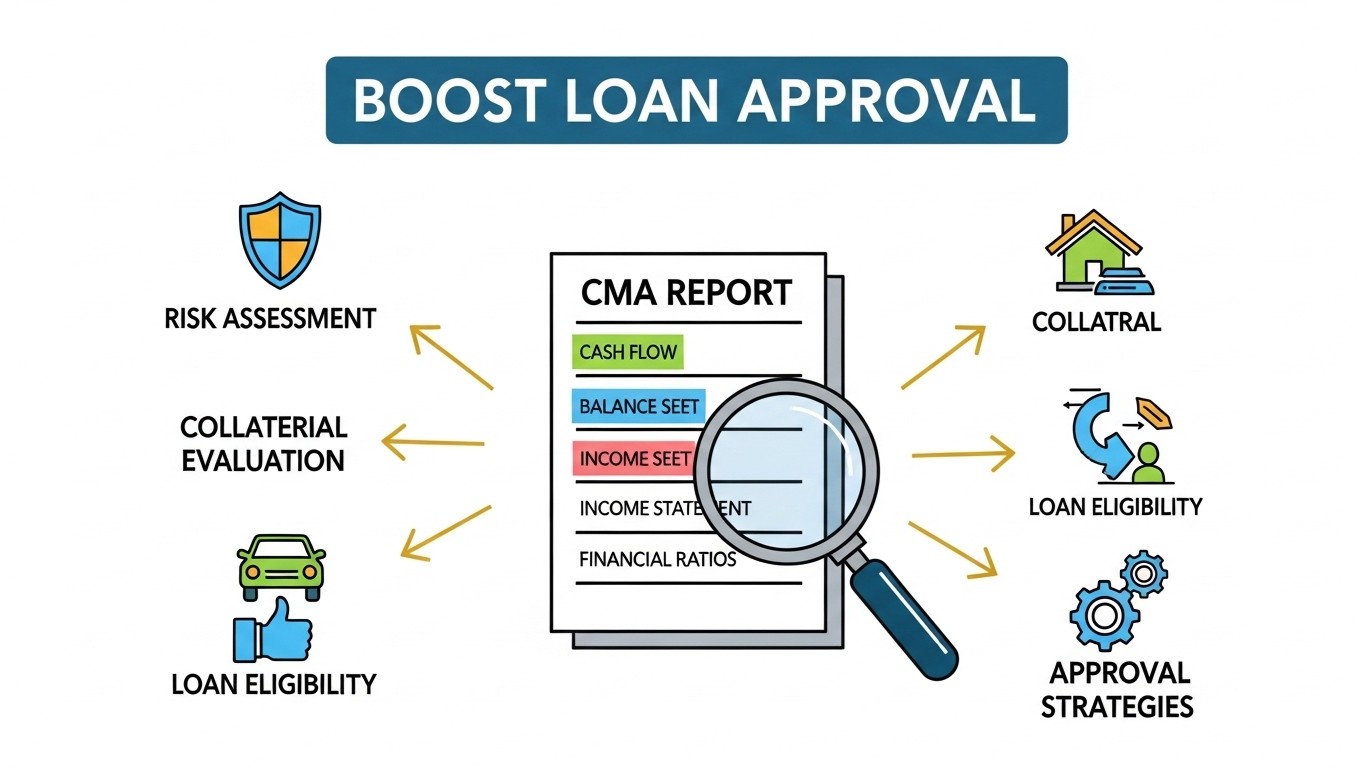

Understanding the CMA Report: Your Key to Loan Approval
You see, Securing a bank loan often hinges on the strength of your financial presentation. The Credit Monitoring Arrangement (CMA) report is a vital tool in this process, providing a full overview of your business's financial health. A well-prepared CMA report can in a big way increase your chances of approval. This guide will explore into the critical components of a CMA report, providing understanding and techniques to improve its accuracy and impact.
What is a CMA Report?
A CMA report is a structured financial document that provides a detailed analysis of a business's past, present. Also, projected financial performance. Banks and financial institutions use it to assess a borrower's creditworthiness and ability to repay a loan. It's more than just a collection of financial statements; it's a narrative that tells the story of your business's financial health and future prospects.
Key Components of a CMA Report
A standard CMA report usually includes the following sections:
- Operating Statement (Profit & Loss Account): Presents the company's revenues, expenses. Also, profitability over a specific period (usually the last 3-5 years and projected figures).
- Balance Sheet: Provides a snapshot of the company's assets, liabilities. Also, equity at a specific point in time (again, historical and projected).
- Ratio Analysis: Calculates and analyzes key financial ratios to assess the company's liquidity, solvency, profitability, and efficiency.
- Fund Flow Statement: Tracks the movement of funds within the company, highlighting sources and uses of cash.
- Comparative Statements: Compares financial data across different periods to identify trends and patterns.
- Projections: Presents forecasted financial statements based on assumptions about future sales, expenses, and investments.
In-Depth Data Analysis for Each Section
1. Operating Statement (Profit & Loss Account) Analysis
This section is key for demonstrating the profitability and revenue-generating capacity of your business. Banks pay close attention to trends in revenue growth, cost of goods sold (COGS), operating expenses, and net profit margin.
Key Data Points:
- Revenue Growth: Consistent revenue growth demonstrates market demand and effective sales strategies. Analyze the growth rate over the past 3-5 years and explain any significant fluctuations.
- Gross Profit Margin: Indicates the profitability of your core business operations. A higher gross profit margin suggests efficient production and pricing strategies.
- Operating Expenses: Track trends in operating expenses (e.g., salaries, rent, marketing) as a percentage of revenue. Identify any areas where costs are increasing disproportionately.
- Net Profit Margin: The ultimate measure of profitability. A healthy and stable net profit margin is essential for loan repayment.
Analytical Techniques:
- Trend Analysis: Plot revenue, COGS. Also, operating expenses on a graph to visualize trends over time.
- Common-Size Analysis: Express each line item as a percentage of revenue to help comparisons across different periods. This helps identify areas where costs are increasing relative to sales.
- Break-Even Analysis: Find out the sales volume required to cover all fixed costs. This helps assess the sensitivity of your profitability to changes in sales.
2. Balance Sheet Analysis
The balance sheet provides understanding into the company's financial structure and solvency. Banks assess the company's ability to meet its short-term and long-term obligations based on the balance sheet data.
Key Data Points:
- Current Assets: Include cash, accounts receivable. Also, inventory. Sufficient current assets are essential for meeting short-term obligations.
- Current Liabilities: Include accounts payable, short-term loans. Also, accrued expenses.
- Working Capital: The difference between current assets and current liabilities. A positive working capital balance indicates sufficient liquidity.
- Fixed Assets: Include property, plant. Also, equipment (PP&E). These assets represent the company's long-term investments.
- Long-Term Debt: Represents the company's long-term borrowing. A high level of long-term debt can increase financial risk.
- Equity: Represents the owners' stake in the company. A strong equity base provides a cushion against losses.
Analytical Techniques:
- Ratio Analysis (Liquidity Ratios): Calculate current ratio (current assets / current liabilities) and quick ratio (excluding inventory) to assess the company's ability to meet short-term obligations.
- Debt-to-Equity Ratio: Measures the proportion of debt financing relative to equity financing. A high ratio indicates higher financial risk.
- Asset Turnover Ratio: Measures how without wasting time the company is using its assets to generate revenue.
3. Ratio Analysis: The Heart of the CMA Report
Ratio analysis is a critical component of the CMA report. It provides a standardized way to assess the company's financial performance and compare it to industry benchmarks. Select ratios relevant to your industry and the specific loan requirements.
Key Ratio Categories:
- Liquidity Ratios: (Current Ratio, Quick Ratio) - Assess the company's ability to meet short-term obligations.
- Solvency Ratios: (Debt-to-Equity Ratio, Debt-to-Asset Ratio) - Assess the company's long-term financial stability.
- Profitability Ratios: (Gross Profit Margin, Net Profit Margin, Return on Equity, Return on Assets) - Measure the company's profitability.
- Efficiency Ratios: (Inventory Turnover Ratio, Accounts Receivable Turnover Ratio, Asset Turnover Ratio) - Measure how fast the company is using its assets.
Presenting Ratio Data:
- Trend Analysis: Show how key ratios have changed over time.
- Benchmarking: Compare your company's ratios to industry averages.
- Explanation: Provide clear explanations for any significant variances in ratios.
4. Fund Flow Statement Analysis
The fund flow statement provides understanding into the sources and uses of funds within the company. This helps banks understand how the company is managing its cash flow and investing in its future.
Key Sections:
- Funds from Operations: Cash generated from the company's core business activities.
- Funds from Investing Activities: Cash flows related to the purchase and sale of fixed assets and investments.
- Funds from Financing Activities: Cash flows related to debt, equity, and dividends.
Analytical Techniques:
- Identify Key Sources of Funds: Figure out whether the company is mostly relying on operations, debt, or equity to fund its activities.
- Analyze Uses of Funds: Track how the company is using its cash – for investments, debt repayment, or dividends.
- Assess Cash Flow Stability: Evaluate the consistency of cash flows from operations.
5. Projections: Painting a Picture of the Future
Projections are a vital part of the CMA report, as they demonstrate the company's ability to repay the loan in the future. Realistic and well-supported projections are essential for gaining the bank's confidence.
Key Considerations:
- Realistic Assumptions: Base your projections on realistic assumptions about sales growth, expenses, and market conditions.
- Support Your Assumptions: Provide evidence to support your assumptions, such as market research data, industry trends. Also, historical performance.
- Sensitivity Analysis: Conduct sensitivity analysis to assess the impact of different scenarios on your projections.
- Conservative Way: It's most of the time better to be conservative in your projections rather than overly optimistic.
Presenting Projections:
- Clear and Concise: Present your projections in a clear and concise manner, using tables and charts.
- Explain Key Drivers: Clearly explain the key drivers behind your projections.
- Highlight Key Ratios: Project key financial ratios to demonstrate the expected improvement in the company's financial performance.
Improving Your CMA Report Accuracy
- Use Accurate Data: Make sure that all financial data is accurate and consistent across all sections of the CMA report.
- Follow Accounting Standards: Follow to most of the time accepted accounting principles (GAAP) or other relevant accounting standards.
- Seek Professional Advice: Consult with a qualified accountant or financial advisor to make sure that your CMA report is accurate and complete.
- Regularly Update Your Report: Keep your CMA report up-to-date with the latest financial information.
Conclusion: The CMA Report as a Careful Tool
So, The CMA report is more than just a formality; it's a planned tool that can a lot impact your ability to secure a bank loan. By understanding the key components of the CMA report, analyzing the data useful, and presenting a compelling financial narrative, you can increase your chances of success. Remember to focus on accuracy, realism. Also, clear communication. A well-prepared CMA report demonstrates your financial acumen and builds trust with the lender.